The Wings
They speak of an identity made for freedom. Even restrained, they remain evidence of what captivity cannot redefine.
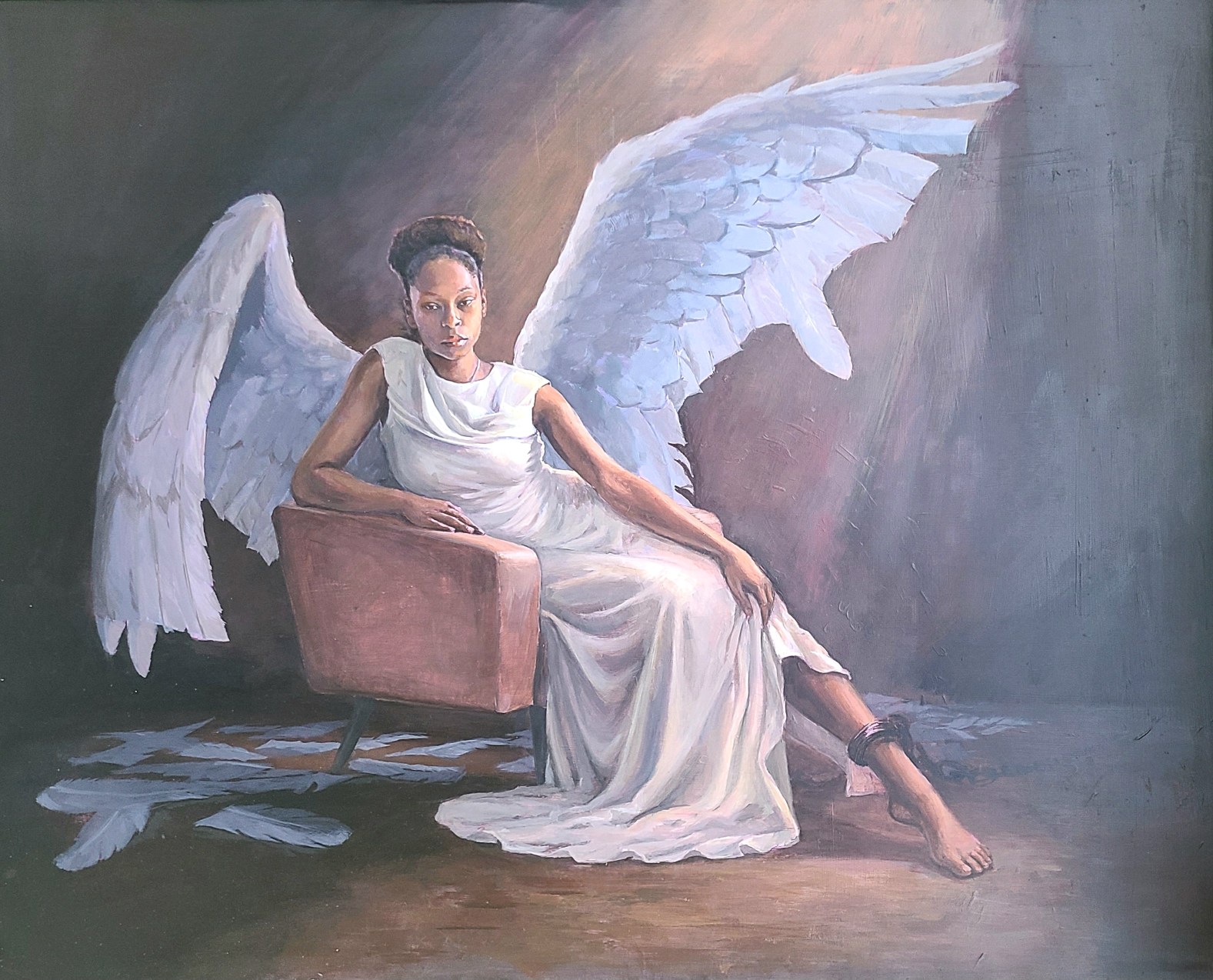
She has wings. She has dignity. Yet she cannot leave.
Look closer ↓What do you notice first?
What seems beautiful? What feels uncomfortable? What might be hidden in plain sight?
Discover the story behind the painting ↓When I was about fourteen years old, growing up in Kenya, I came across two wild geese moving through the bushes of our large compound.
They weren't alone.
With them was a brood of young birds.
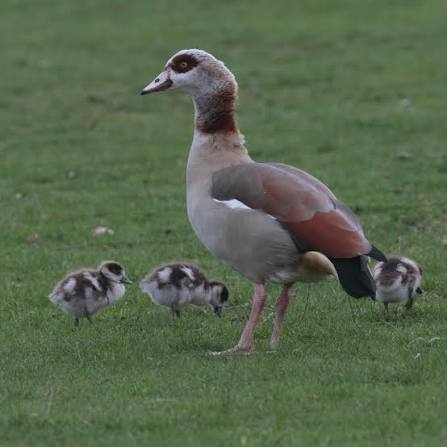
To the adventurous fourteen-year-old that I was, this was an extraordinary discovery. I called my brother and siblings and, despite the desperate attempts of the adult birds to protect their young, we managed to capture every one of them.
I remember returning home feeling like a hero.
I was now the proud owner of these beautiful, mysterious wild birds.
We built an enclosure for them alongside our chickens. The young geese grew there—eating with the chickens, walking with them and becoming part of the familiar landscape of our home.
But their parents knew where they were.
They would fly over our compound, calling to them.
And as the young birds grew older, something began to happen.
They started trying to fly.
Their wings were telling them something that their captivity could not erase:
they were not born to remain on the ground.
My brother saw the problem before I did.
If we wanted to keep them, we would have to prevent them from flying away.
So we cut their flight feathers.
I remember holding those beautiful birds, one by one, while their feathers were trimmed with scissors.
And it worked.
They remained with us.
Their feathers eventually grew back, of course, so we clipped them again.
And again.
They were still beautiful.
Still graceful.
Still recognisably wild geese.
But they could no longer go where their own wings were designed to take them.
That childhood memory stayed with me.
Eventually we stopped clipping their feathers. Their wings grew back and, one after another, the birds flew away.
Years later, as I began learning more about human trafficking, that memory returned to me differently.
I began thinking about what it means to take something that was born with freedom and deliberately create conditions that prevent it from exercising that freedom.
Human trafficking does something far more devastating to human beings.
People can be controlled, exploited and stripped of dignity, identity and choice. And unlike the birds from my childhood, freedom does not simply return because a captor grows tired of keeping them.
That is where this painting began.
They speak of an identity made for freedom. Even restrained, they remain evidence of what captivity cannot redefine.
Control can be physical, psychological, economic or hidden. The chain makes visible the loss of choice at the centre of exploitation.
Something has been deliberately taken from her. The clipped feathers echo the repeated act of preventing flight.
One wing still reaches upward. The image refuses to let captivity have the final word on dignity, identity or possibility.
Human trafficking exploits people by taking away freedom, choice and dignity for another person's gain. Why Am I Here? does not attempt to tell every survivor's story. It asks us to notice the human being behind the issue—and to refuse indifference.
The work belongs to SEEN — An Art Series for Freedom, Kunst Elevate's impact initiative using art to bring attention to human trafficking, human dignity and freedom, and to move awareness towards community and action.
Explore SEEN →Art begins to create impact when it opens a conversation. Share a thought, question or feeling that stayed with you.
A work of art does not have to stop at the canvas. Why Am I Here? can continue its journey through the person who owns it, the spaces in which it is shown and the conversations it helps create.
Why Am I Here? is available for acquisition. If this artwork speaks to you, you are invited to submit an offer for the original 70 × 120 cm painting.
Request a fine-art print of Why Am I Here?. Register your interest and Kunst Elevate will share available sizes, editions and pricing.
Feature the artwork in a campaign, workshop, school, organisation, exhibition, community dialogue or social-impact programme.
A percentage of the final sale of Why Am I Here? will be dedicated to supporting work addressing human trafficking through SEEN — An Art Series for Freedom.
The final contribution and beneficiary will be published here as part of the artwork's Impact Record, creating a transparent account of how the work moves from conversation into action.
Public presentation of Why Am I Here? and the beginning of Kunst Elevate's human-trafficking impact initiative.
This record will grow as the artwork enters new spaces, conversations and communities.